Periodicals
JACS Au
Authors
Jiuchuang Yuan ,Mingjun Yang , Fan Yan , Jing Guo , Lin Zhang , Guosheng Dou , Minjun Liu , Lu Tan , Liwen Fang , Guanfeng Yang , Qun Zeng , Jun Yan , Xuekun Shi , Sarah Trice , Jian Ma , Shuhao Wen , Christopher J. Welch , Peiyu Zhang
Abstract
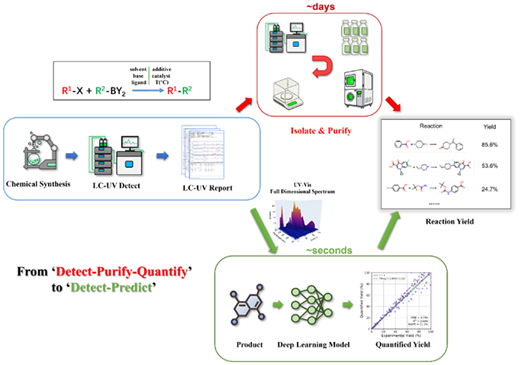
High-throughput experimentation (HTE) accelerates molecular discovery but struggles to quantify yields without pure analyte standards. The current need to purify standards increases cost, complexity, and cycle time, limiting the scalability of new molecular discovery. Here, we introduce an integrated “detect-predict” framework that leverages artificial intelligence (AI) for analyte standard-free yield quantification. This approach hierarchically trains a prediction model of full-spectrum UV correction factor (CF) by combining quantum chemistry (QC) pre-training on 22,609 compounds for broad chemical space coverage with experimental fine-tuning on 1,845 LC-UV spectra to adapt to real instrumental conditions, thereby mitigating spectral discontinuities and data heterogeneity between computational and experimental domains. These predicted CFs enable direct quantification of analyte concentrations and reaction yields from UV absorbance data.We validated the accuracy of this framework through three independent test cases. First, concentration estimation was tested against 144 FDA compounds with known experimental concentrations. Second, yield quantification for 178 real-world reactions (spanning amide coupling, Suzuki–Miyaura coupling, SN2, and Buchwald-Hartwig transformations) was compared with calibration-curve-derived yields, achieving a mean absolute error of 4.7%. Finally, model-quantified yields were compared with isolated yields for 60 reactions as practical stress tests. The systematic positive bias aligned with the expected difference between crude analytical yield and post-purification isolated yield, enabling chemists to distinguish reaction performance from workup losses.This capability is critical for decision-making in real-world optimization. This AI-driven “detect-predict” framework offers an alternative to the traditional “detect-purify-quantify” workflow, providing a faster and more scalable foundation for HTE-accelerated molecular discovery.
Visual Abstract
Full PDF: